
Volkswagen Touran Owners Manual: Handling of wheels and tyres
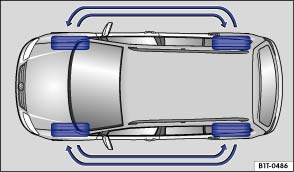
Fig. 183 Changing wheels
 First read and observe the introductory
information and safety warnings
First read and observe the introductory
information and safety warnings The tyres are the most used and most underestimated parts of a vehicle. Tyres are very important as the narrow tyre surfaces are the only contact between the vehicle and the road.
The service life of tyres is dependent on tyre pressure, driving style handling and fitting.
The tyres and wheel rims are an essential part of the vehicle's design. The tyres and rims approved by Volkswagen are specially matched to the characteristics of the vehicle and make a major contribution to good road holding and safe handling.
Avoiding damage to the tyres
- If you have to drive over a kerb or similar obstacle, drive very slowly and as near as possible at a right angle to the kerb.
- Inspect the tyres regularly for damage such as cuts, cracks or blisters.
- Remove foreign objects that are in the outer tyre profile and have not penetrated the inner tyre .
- Always respond to any warning messages given by the tyre monitoring system .
- Damaged or worn tyres must be replaced immediately .
- Regularly check the tyres for hidden damage .
- Never exceed the top speed and load permitted for the tyres that are fitted .
- Protect the wheels, including the spare wheel, from contact with corrosive substances, including oils, lubricants, fuel and brake fluid .
- Replace missing dust caps immediately.
Tyres with directional tread pattern
Tyres with directional tread pattern have been developed to roll in one direction only. An arrow on the tyre sidewall indicates the direction of rotation on tyres with directional tread . The direction of rotation must be adhered to. This is the only guarantee for optimum grip and helps to avoid aquaplaning, excessive noise and wear.
If, however, the tyre is fitted in the opposite direction to the tread pattern, you must take more care when driving as the tyre is now no longer being used according to its designation. This is particularly important on wet roads. The tyres must be replaced as quickly as possible or be fitted with the tread in the correct direction.
Rotating wheels front to rear (does not apply to the CrossTouran)
A regular rotation of the wheels as shown in the illustration is recommended to ensure a uniform level of wear for the tyres. All the tyres will then last for about the same time.
Volkswagen recommends having the wheels changed by a qualified workshop.
Rotating wheels front to rear (CrossTouran only)
The tyres and wheels fitted are of different sizes at the front and rear. Tyres and wheels on the front axle must never be exchanged for wheels and tyres from the rear axle (and vice versa).
Volkswagen recommends having the wheels changed round by a qualified workshop .
Tyres which are older than 6 years
Tyres age through physical and chemical processes which can impair their function. Tyres which are stored unused for an extended period will harden and become brittle more quickly than tyres which are in constant use.
Volkswagen recommends replacing tyres which are older than six years with new tyres. This also applies for tyres, including the spare wheel, which appear to still be in good condition and whose tread depth has not yet reached the minimum value stipulated by legislation .
The age of a tyre can be determined by the manufacture date, which is a component of the tyre identification number (TIN) .
Storing tyres
Mark tyres before you remove them to indicate the direction of rotation. This ensures you will be able to mount them correctly when you replace them (left, right, front, rear). When removed, the wheels or tyres should be stored in a cool, dry and preferably dark place. Do not store tyres mounted on the rim vertically.
Any tyres without wheels should be protected against dirt and stored standing on the tread.

 WARNING
- All four wheels must be fitted with radial tyres of the same type, size (rolling circumference) and the same tread pattern.
- On the CrossTouran, the size of the tyres and wheels fitted at the front is different to those at the rear. Tyres and wheels on the front axle must never be exchanged for wheels and tyres from the rear axle (and vice versa).
WARNING
- Always keep chemicals, oils, lubricants, fuel, brake fluid and other corrosive substances away from the tyres.
WARNING
- Avoid using tyres that are more than six years old. If you have no alternative, drive slowly and with extra care at all times.

Old tyres should be disposed of as required by legislation.
 Introduction
This chapter contains information on the following subjects:
→ Handling of wheels and tyres
→ Rims
→ New wheels and tyres
→ Tyre pressure
â ...
 Rims
Rims
First read and observe the introductory
information and safety warnings The design of the wheel bolts is matched
to the rims. If different rims are fitted, the correct wheel bolts with the
rig ...
Other materials:
Volkswagen Touran Owners Manual. Cleaning stowage compartments, drink holders and ash trays
First read and observe the introductory
information and safety warnings Cleaning stowage compartments and
drink holders
Some stowage compartments and drink holders have a removable rubber insert in
the base.
Moisten a clean, lint-free cloth with water and clean the parts.
If this ...
Volkswagen Touran Service Manual. Light Alloy Wheels, Care and Maintenance
To maintain the decorative appearance of light alloy wheels
for a long time, regular care is necessary.
In particular, road salt and dust from brake abrasion must
be thoroughly washed off every two weeks. Otherwise, the paint
of the ligh ...
